
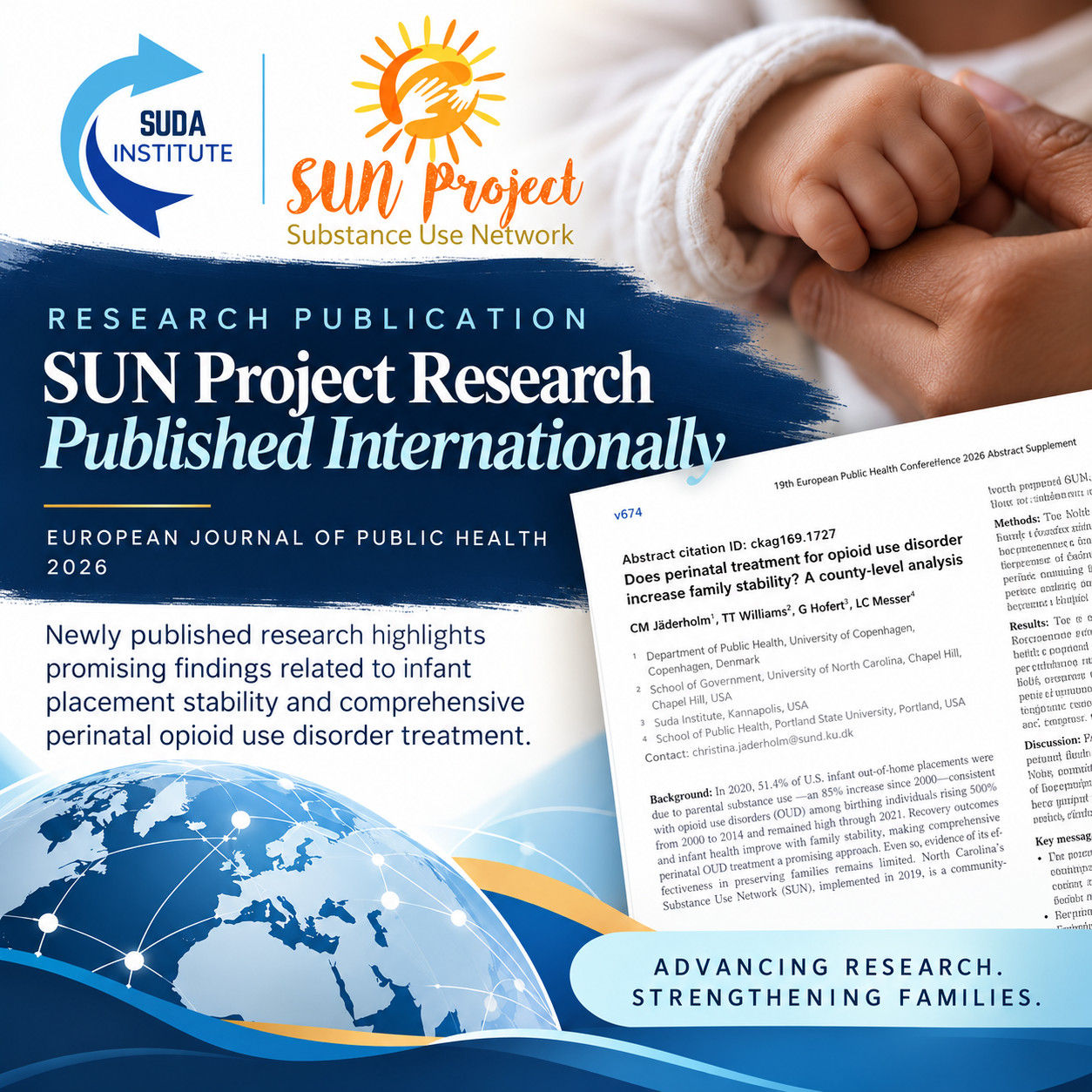
Newly published research in the European Journal of Public Health highlights promising findings related to infant placement stability and comprehensive perinatal opioid use disorder treatment.
The Suda Institute is proud to announce the publication of a research abstract titled “Does Perinatal Treatment for Opioid Use Disorder Increase Family Stability? A County-Level Analysis” in the European Journal of Public Health, as part of the 19th European Public Health Conference 2026 Abstract Supplement.
The research includes The Suda Institute’s Chief Executive Officer, Gina Hofert, as a co-author, alongside researchers from the University of Copenhagen, the University of North Carolina at Chapel Hill, and Portland State University.
This publication represents an exciting milestone in our ongoing efforts to advance compassionate, comprehensive care for pregnant and postpartum individuals affected by opioid use disorder (OUD).
What Did the Research Find?
The study examined the impact of North Carolina’s Substance Use Network (SUN), a community-based perinatal opioid use disorder treatment model implemented in 2019, on infant out-of-home placements.
Researchers analyzed county-level data from 2015 through 2021, comparing counties implementing SUN with counties that did not have the intervention.
The findings highlighted encouraging improvements in infant placement outcomes:
- Shorter time in out-of-home placement: The average number of days infants spent in out-of-home placement decreased by approximately 182 days in SUN counties following implementation, compared with a decrease of approximately 74 days in non-intervention counties.
- Improved placement stability: The percentage of infants experiencing only one placement increased by 25% in SUN counties, while non-intervention counties experienced no change.
- No change in overall placement rates: Although the rate of infants entering out-of-home placement did not change, improvements in placement duration and stability suggest meaningful benefits associated with comprehensive perinatal treatment.
These findings demonstrate a promising association between SUN’s implementation and improved infant placement outcomes, reinforcing the importance of coordinated, patient-centered approaches to supporting families affected by opioid use disorder.
Why This Research Matters
For pregnant and postpartum individuals navigating opioid use disorder, access to comprehensive treatment and coordinated support can play an important role in recovery, family well-being, and long-term stability.
The findings suggest that comprehensive perinatal opioid use disorder treatment may help reduce the length and disruption of infant out-of-home placements, even when the overall number of placements remains unchanged.
This research also highlights the importance of collaboration between healthcare providers, child welfare systems, community organizations, and individuals with lived experience.
At The Suda Institute, these partnerships are central to our mission of improving outcomes for pregnant and postpartum individuals and their families through education, collaboration, advocacy, and compassionate care.
Sharing Our Work on an International Stage
The publication provides an opportunity to contribute to international public health discussions surrounding maternal health, substance use disorders, and family stability.
We are grateful to the research team, our community and clinical partners, and the individuals and families whose experiences continue to inform this important work.
We are especially proud to see the SUN Project represented in research that may help inform future approaches to perinatal treatment and child welfare coordination.
Read the Published Research Abstract
Title: Does Perinatal Treatment for Opioid Use Disorder Increase Family Stability? A County-Level Analysis
Authors: CM Jäderholm, TT Williams, G Hofert, and LC Messer
Publication: European Journal of Public Health, Volume 36, Supplement 5 (2026)
Read the Published Abstract Here
The Suda Institute remains committed to advancing approaches that recognize the dignity, strengths, and individual needs of pregnant and postpartum people affected by substance use disorders.
Because supporting recovery means supporting families, strengthening connections, and creating opportunities for lasting stability.
Learn more about our mission and the SUN Project at www.sudainstitute.org.